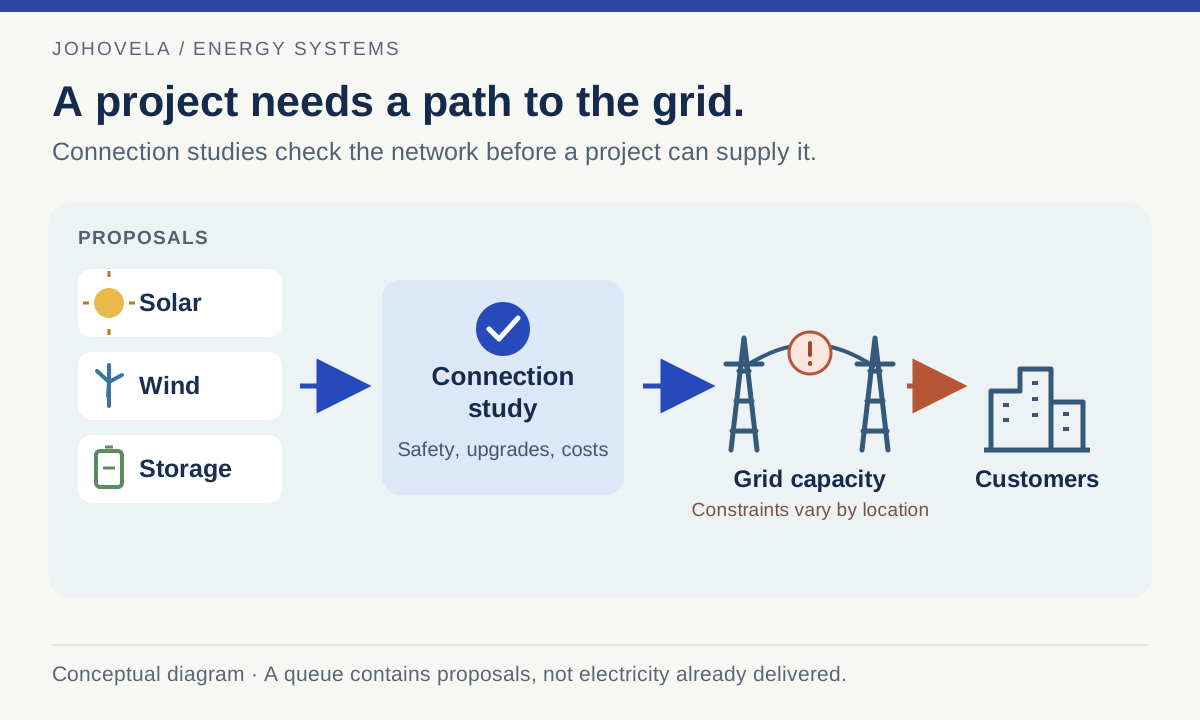
A solar farm can have a suitable site and interested investors yet still wait years before it can deliver power. The missing piece is often a safe, agreed connection to the electricity network. The wires, substations and operating rules between a project and its customers matter as much as the generator itself.
A grid connection queue, also called an interconnection queue, is the list of proposed projects going through that process. It is a sign of development interest, not a promise that every project will be built or a measurement of energy already delivered.
What happens after a developer applies?
Imagine a solar project seeking to connect to a transmission line. The operator must examine what happens when the project generates, when demand changes, and when equipment is unavailable. Studies can identify whether the connection needs new equipment or upgrades and who will pay for them. The project also needs other pieces, such as land agreements, permits, financing and equipment.
These steps interact. A grid can be constrained at a substation or on a line even when there is demand for electricity elsewhere. Other projects seeking the same network capacity can affect the studies and the cost allocation. This is an explanation of the process; the exact order and requirements depend on the operator and country.
In its 2026 electricity report, the International Energy Agency says that grid construction can take roughly five to fifteen years, including planning and permitting. Those ranges are broad, not a construction schedule for a particular project. The same report describes congestion and connection queues as challenges in multiple regions.

Read queue headlines carefully
In July 2026, Lawrence Berkeley National Laboratory reported about 2,061 gigawatts of proposed generation and storage capacity active in United States interconnection queues at the end of 2025. A gigawatt describes rated power, not the amount of electricity a project would deliver over a year. Storage can take in power as well as provide it, so it should not be counted as a new primary energy source.
The laboratory also found that the volume of active requests had fallen 10% from the end of 2024, alongside many withdrawals. Among capacity requesting connection during 2000–2020, 13% had reached operation by the end of 2025 and 75% had withdrawn; outcomes for more recent requests were not all known. Those historical figures are not a forecast for a particular new project.
The list therefore cannot be read as a pipeline of guaranteed construction. Nor does a withdrawal automatically prove that the grid was the only problem. Project economics, land, permits and financing can matter too.
Can the existing wires carry more?
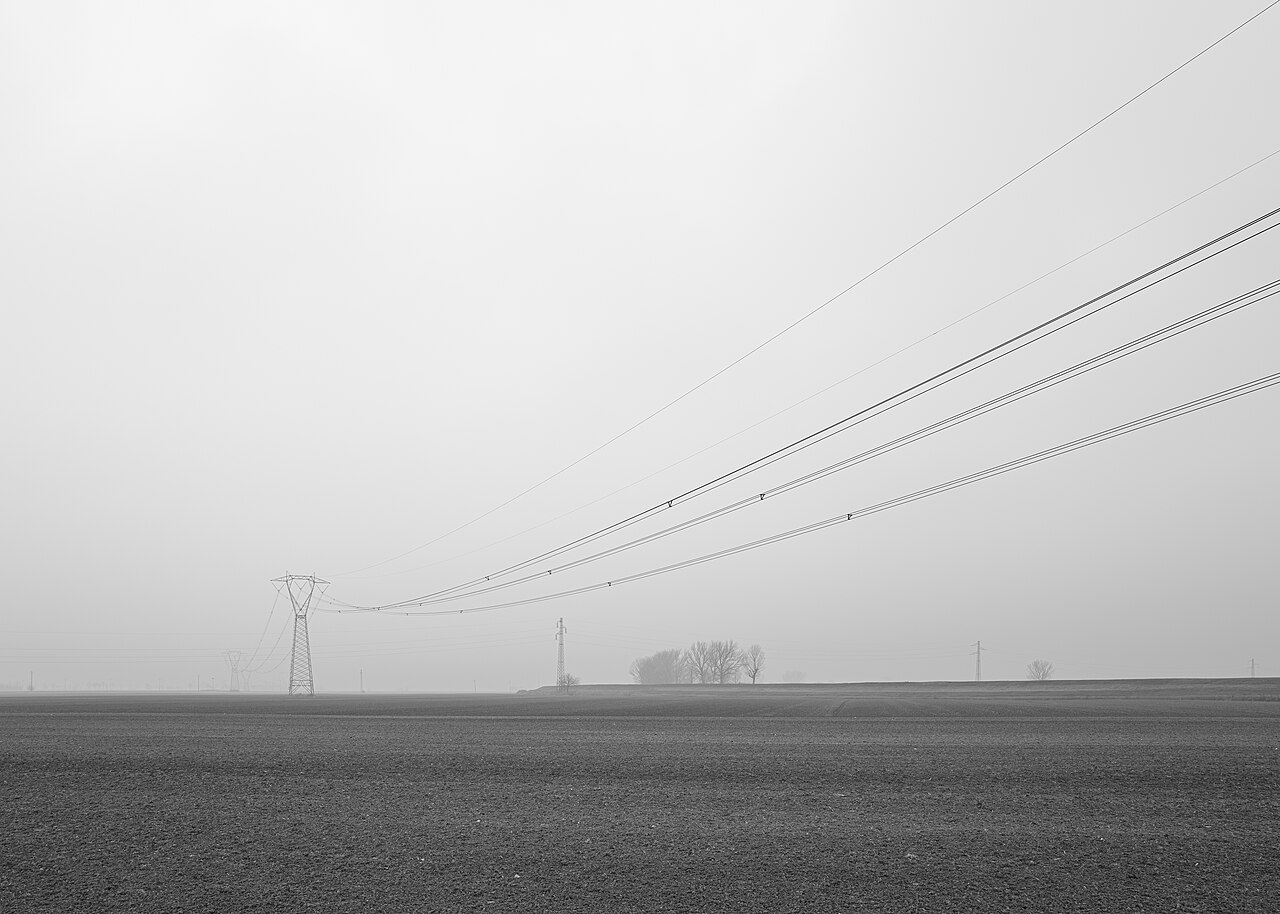
One approach is to measure how conditions affect an overhead line. A conductor heats up as current flows, while wind and cooler air can help it shed heat. With dynamic line rating, operators use weather or line measurements to adjust a line’s rating to the conditions rather than relying on a fixed conservative assumption.
The US Department of Energy’s conductor report explains that favorable conditions can allow a higher rating, while hot, still conditions can require a lower one. The extra capacity is therefore variable. It cannot be treated as a permanent increase that exists at every hour, or as a cure for a substation or voltage constraint elsewhere.
Other approaches include replacing conductors, adding lines and substations, sharing connections, or offering an agreement that allows a project’s output to be limited at certain times. The IEA notes that such non-firm agreements can accelerate access but come with that restriction. Which combination makes sense requires a study of the actual network.
The useful question
When you see a headline about a large queue, ask three things: What kind of capacity is counted? How many projects are still proposals? What constraint is being addressed? The answers distinguish real investment interest from power already serving homes, and a promising grid tool from a universal solution.
Keep the evidence in view.
Queue figures count proposed capacity, not electricity delivered or projects certain to be built. Rules and constraints differ between power systems.
Technical sources checked: . Our source check: . This is an AI-assisted editorial explanation, not an independently reproduced experiment.
Sources & further reading
- Lawrence Berkeley National Laboratory, July 2026Backlog of power plants seeking transmission grid connection eased somewhat in 2025 amidst high withdrawals
- International Energy Agency, February 2026Electricity 2026: Grids
- US Department of Energy, December 2023Advanced Conductor Scan Report