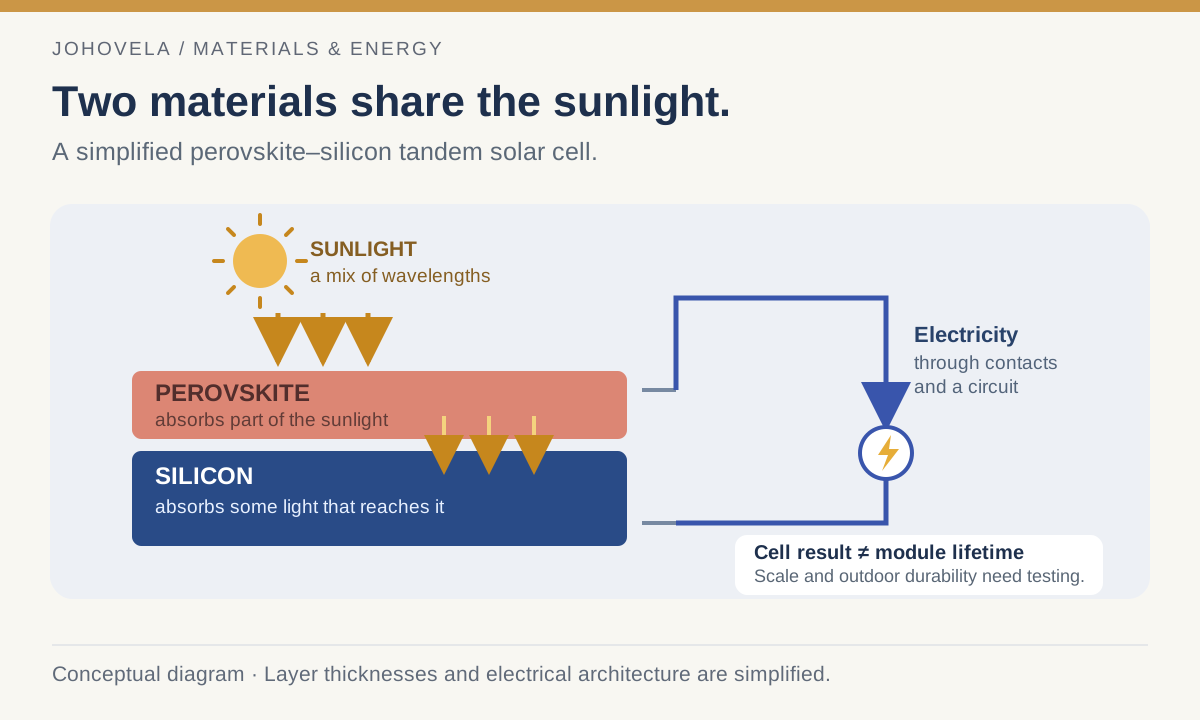
A solar panel has only so much space on a roof. A cell that turns more of the sunlight falling on it into electricity could deliver more power from the same area. Researchers are testing one way to do that: stack two different light-absorbing materials so each can use a different part of the sunlight.
A perovskite–silicon tandem combines a thin perovskite layer with silicon. The idea is promising, but a small, high-efficiency research cell is not automatically a large panel that can survive years outdoors.
Why use two materials?
Sunlight contains a range of wavelengths. A solar cell absorbs light and uses it to move electric charge, producing power. A single material cannot use every part of that spectrum equally well.
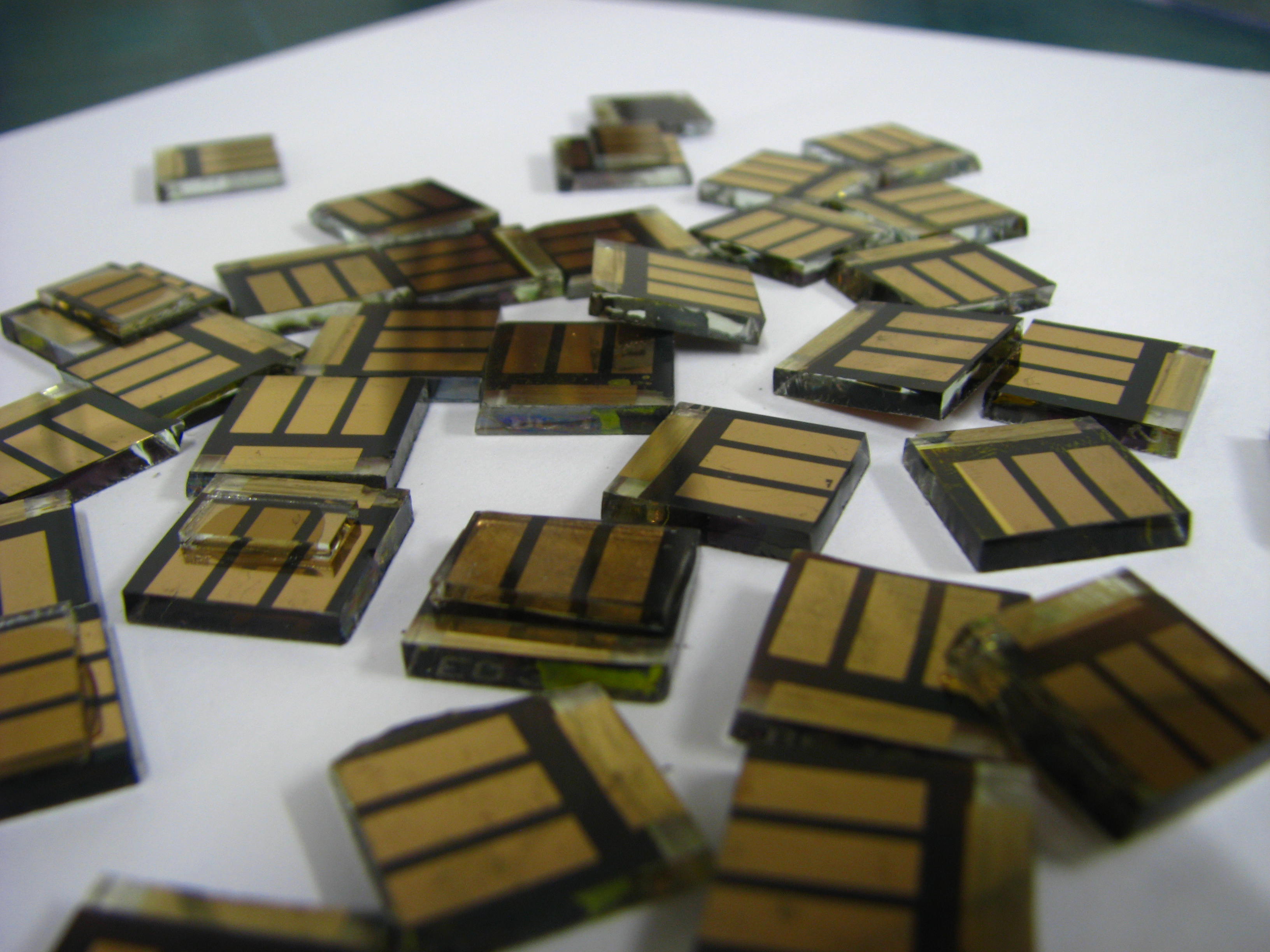
Perovskites are a family of materials; the metal-halide varieties used in these solar cells can be adjusted through their composition. The US Department of Energy explains that a perovskite layer can be stacked with silicon so the layers use different parts of the incoming light. The combination is called a tandem cell.
The picture is deliberately simplified. The complete device also needs layers and contacts that help collect current. A successful stack requires those layers to work together without wasting too much light or energy.

A record is a measurement, not a rooftop guarantee
The Department of Energy’s research overview gives a perovskite–silicon tandem research-cell efficiency of 33.9%, as of April 21, 2024. The percentage measures the share of incident light converted to electrical power in the stated test. It is a dated small-device result, not a current record claimed for every manufacturer or the output of an installed panel.
A module consists of interconnected cells, packaging and protective layers. Moving from a small device to a larger area introduces manufacturing and electrical challenges. Outdoor output also changes with sunlight, temperature, shading and installation. A cell’s laboratory percentage alone cannot tell a homeowner how many kilowatt-hours a rooftop system will generate over a year.
Development has moved beyond lab-only work. In April 2026, manufacturer Tandem PV announced a commercial demonstration factory producing tandem panels in California. That is a company-reported manufacturing milestone; it does not independently establish long-term field lifetime, production volume or performance across all tandem products.
What must survive outdoors?
Solar panels encounter heat, light, moisture and changing weather. The energy department notes that perovskite devices can degrade under stress from moisture, oxygen, light and heat; the device’s other layers and packaging matter as well. Researchers are testing materials, interfaces and encapsulation to improve durability.
The same overview gives a specific example from April 2024: small perovskite minimodules around 25 square centimeters, with 15–18% aperture-area efficiency, had not fallen to 80% of their initial efficiency after five months outdoors. These were perovskite minimodules, not proof that every perovskite–silicon tandem panel will last for decades. Five months of exposure is not a twenty-year lifetime test.
Testing methods matter because conditions differ across experiments. The Department of Energy has published proposed and revised performance targets covering efficiency, module size and durability checks. Those targets describe what researchers may aim to demonstrate; they are not evidence that all devices have already met them.
Ask better questions about a solar breakthrough
When reading a tandem-solar headline, check the size and type of the device, how its efficiency was measured, whether a third party verified it, and what outdoor or accelerated durability testing was performed. Then ask whether the result describes research, a manufacturing demonstration or an available product.
The tandem idea offers a real way to use sunlight more effectively. Its practical value will depend on translating that idea into repeatable production and well-measured outdoor performance, not just the highest number reported for a small cell.
Keep the evidence in view.
The cited efficiency and outdoor exposure results describe small research devices under specified conditions, not guaranteed performance or lifetime of a commercial rooftop module.
Technical sources checked: . Our source check: . This is an AI-assisted editorial explanation, not an independently reproduced experiment.
Sources & further reading
- US Department of EnergyPerovskite Solar Cells
- US Department of EnergyPerovskite Research Directions
- US Department of EnergyPerformance targets for perovskite photovoltaics research, development and demonstration
- Tandem PV, April 2026Tandem PV Opens California Factory for Next-Generation Solar Manufacturing