A map of a brain’s connections can show possible routes for information to move. It cannot, by itself, tell us everything that happens along those routes. A 2024 fruit-fly study demonstrates both sides of that idea: researchers reconstructed the connections in an adult fly brain, creating a resource for investigating neural circuits.
The reported reconstruction covers 139,255 neurons and about 50 million chemical synapses in one adult female fruit fly. A synapse is a place where one neuron can communicate with another. These numbers describe the reconstructed sample, not a live measurement of signals passing through the brain.
What is a neural network in biology?
A neuron is a cell that can receive and send signals. Its branches connect with other cells, forming circuits that contribute to how an animal senses and responds to its environment. A biological neural network is made of living cells; it is related by inspiration to an artificial neural network, but the two should not be assumed to work in the same way.
A connectome is a map of connections in a nervous system or part of one. At this scale, it can show which neurons connect and how their branches travel. This gives researchers a structural starting point for asking which paths might participate in a behavior.
From tissue to a map
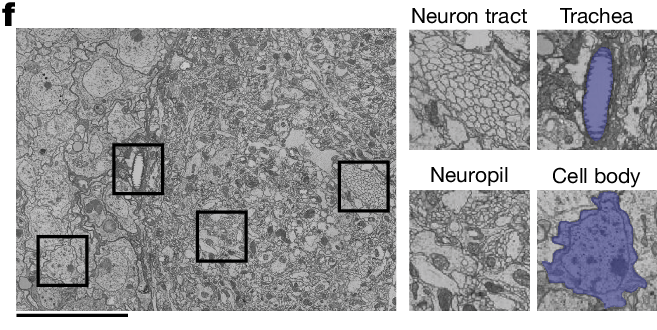
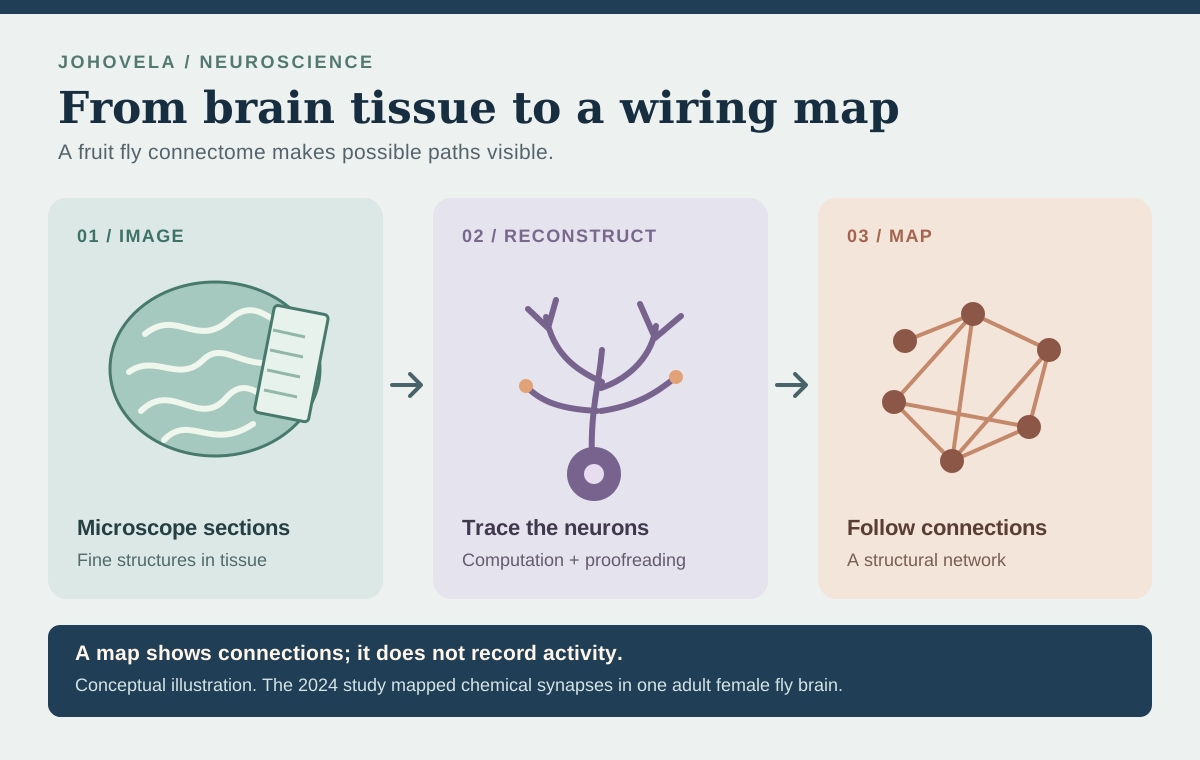
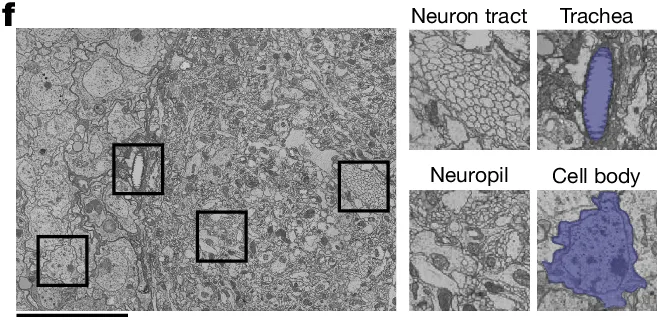
The FlyWire work used an existing set of electron-microscopy images of an adult fly brain. Electron microscopy can show fine cellular structures, but the data do not arrive as a ready-made circuit diagram. The team used computational methods to reconstruct neurons and identify synaptic connections, followed by extensive proofreading of neuron reconstructions by researchers and other contributors.
- Image the tissue. Very thin sections provide detailed views of structures inside the brain.
- Trace cells through the images. Computational reconstruction and human proofreading connect branches that belong to individual neurons.
- Identify connections. Synaptic contacts become edges between the reconstructed cells.
- Ask a circuit question. Researchers can follow candidate paths from sensory inputs toward outputs and test hypotheses in further work.
This is a simplified explanation of the workflow. The paper’s underlying reconstruction involves many technical steps and a large community effort.

A wiring map is not a recording
A street map suggests routes that cars could take, but it does not show the traffic at a particular moment. Similarly, a connectome provides structural information; it does not directly record when neurons fire or explain the full effect of every connection during behavior.
The analogy has limits: neurons are living cells, not roads, and synapses can differ in their properties. The practical point is that researchers combine structure with other evidence, such as measurements of activity or targeted experiments, to investigate what a circuit does.
The 2024 map includes chemical synapses. The authors note that identifying electrical synapses would require a future dataset with higher resolution. No reconstruction should be described as a perfect, complete account of every biological interaction merely because it covers the brain at a large scale.
Why a small fly is useful
Fruit flies are research animals with established tools for studying nervous systems and behavior. A map of one adult fly brain offers researchers a way to trace potential pathways across a whole brain, rather than relying only on a small isolated region.
The paper illustrates this by tracing possible paths from a subset of visual receptors toward descending motor pathways. Such routes can suggest mechanisms for further study. A connection on a map, however, is not by itself proof that a particular path caused an observed action.
| Evidence | What it can help answer |
|---|---|
| Structure | Which cells appear to connect, and along what possible routes? |
| Activity | When do recorded cells or signals change under particular conditions? |
| Intervention | What changes when researchers alter a part of the system under a defined experiment? |
These approaches complement one another. An intervention also needs controls and interpretation; no single row provides a complete explanation of behavior.
What this does and does not map
The resource comes from one fruit fly, not a human participant, and it does not show the animal thinking. Its value is more concrete: it gives researchers a detailed structural resource for asking better questions about circuits, then checking those questions with additional evidence.
Keep the evidence in view.
The map describes one adult female fruit fly brain and its reconstructed chemical synapses. It is not a human brain map or a direct recording of thoughts or behavior.
Technical sources checked: . Our source check: . This is an AI-assisted editorial explanation, not an independently reproduced experiment.
Sources & further reading
- Nature, October 2024; original researchNeuronal wiring diagram of an adult brain
- US National Institute of Mental Health, October 2024Researchers Fully Map Neural Connections of the Fruit Fly Brain