A camera can show where a light is. Measuring that light at different wavelengths can also help reveal what produced it or what it passed through. NASA’s SPHEREx space telescope combines those ideas on a large scale, surveying the sky in infrared wavelengths that human eyes cannot see.
Its name stands for Spectro-Photometer for the History of the Universe, Epoch of Reionization and Ices Explorer. The name is long, but the central idea is approachable: map broadly, then use the distribution of light across wavelengths to ask questions about the universe.
What is infrared light?
Visible light is only part of the electromagnetic spectrum. Infrared light has wavelengths longer than visible light. Many astronomical objects and clouds emit or absorb radiation at infrared wavelengths, giving researchers information that differs from an ordinary visible-light image.
A telescope’s instrument measures incoming light; it does not directly label a region “water” or “dust.” Scientists calibrate the observations and compare patterns of wavelengths with physical models and other measurements. Conclusions depend on the data quality and the assumptions used to interpret it.
A wide map with many measurements
NASA describes SPHEREx as a survey telescope rather than an instrument built to make the same kind of detailed observation as a telescope pointed at a small target. According to the mission overview, it uses filters and overlapping images to measure each section of sky across 102 infrared wavelengths.
- Collect light. The telescope observes a wide area of sky.
- Separate wavelengths. Its filters let different infrared wavelengths reach different parts of the detector.
- Combine observations. Overlapping views build a wavelength-dependent map.
- Interpret patterns. Researchers calibrate the data and compare the measurements with scientific models and other observations.
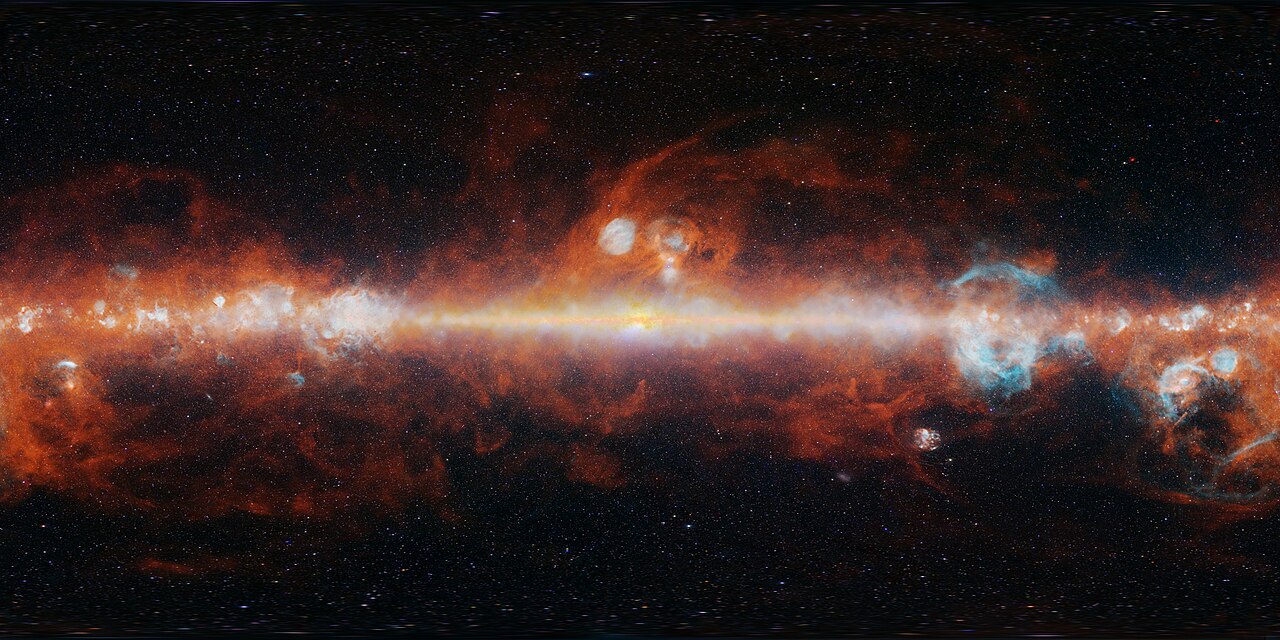
The number 102 describes wavelength channels in the survey, not 102 colors that a person could see unaided. The published composite assigns visible colors to selected infrared data so a reader can inspect the structure.
What can the survey help researchers study?
SPHEREx is intended to contribute to several questions, including the distribution of galaxies and the materials found in and around our galaxy. Different questions require different analyses; a colorful map alone does not answer them.
In an October 2026 NASA report, researchers described observations of 37 nearby brown dwarfs across a range of temperatures. Brown dwarfs form like stars but do not sustain hydrogen fusion in their cores in the way ordinary stars do. Their infrared spectra can help scientists investigate their atmospheres.
NASA notes that Earth’s atmosphere absorbs some wavelengths that SPHEREx can observe from space. That does not make a space telescope universally better than a ground-based instrument: each has its own wavelength coverage, resolution, observing strategy and constraints.
A map is a starting point
A survey makes it possible to find patterns and candidate targets across a large area. A more focused instrument may then examine an object in greater detail or at different wavelengths. Combining observations helps researchers test competing explanations.
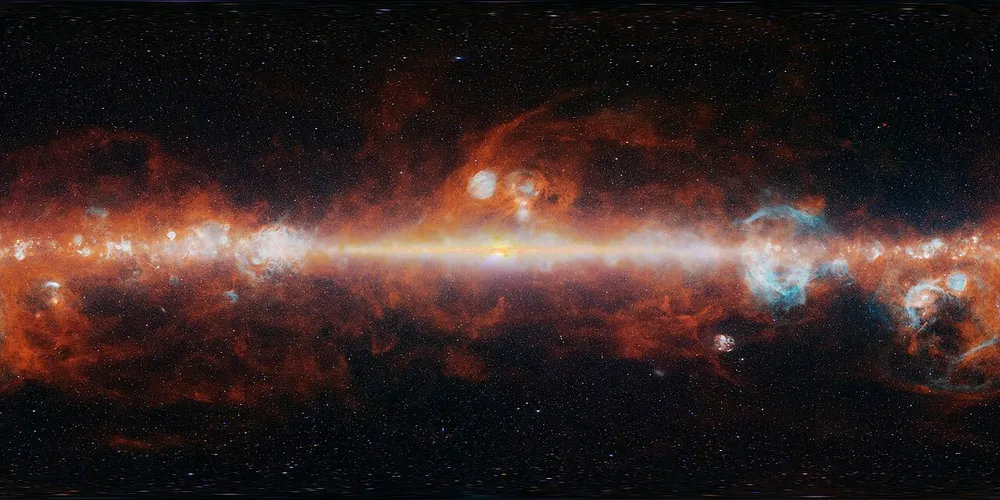
The public image shown here is an all-sky mosaic using selected SPHEREx infrared measurements represented as visible colors. It is a real visualization of observational data, not a photograph in natural human-visible color. Its value is in making measurements interpretable while keeping the distinction between the sky, the instrument and the scientific inference clear.
Keep the evidence in view.
The colored sky image represents selected infrared measurements in visible colors; it is not what the human eye would see, and an observation needs analysis before it becomes a scientific conclusion.
Technical sources checked: . Our source check: . This is an AI-assisted editorial explanation, not an independently reproduced experiment.
Sources & further reading
- NASA, May 2025NASA's SPHEREx Space Telescope Begins Capturing Entire Sky
- NASA, October 2026NASA's SPHEREx Telescope Sees Menagerie of Brown Dwarfs
- NASA Science, March 2025Meet the Spacecraft: SPHEREx